“AI can make idea slop, too.” Andy Azula, the UPS Whiteboard guy, on going back to agency life at West Cary Group
The creative director and on-screen face of UPS's Whiteboard ads joins a 120-person agency in Richmond as ECD. He told us what makes an idea worth paying for when anyone can make anything.
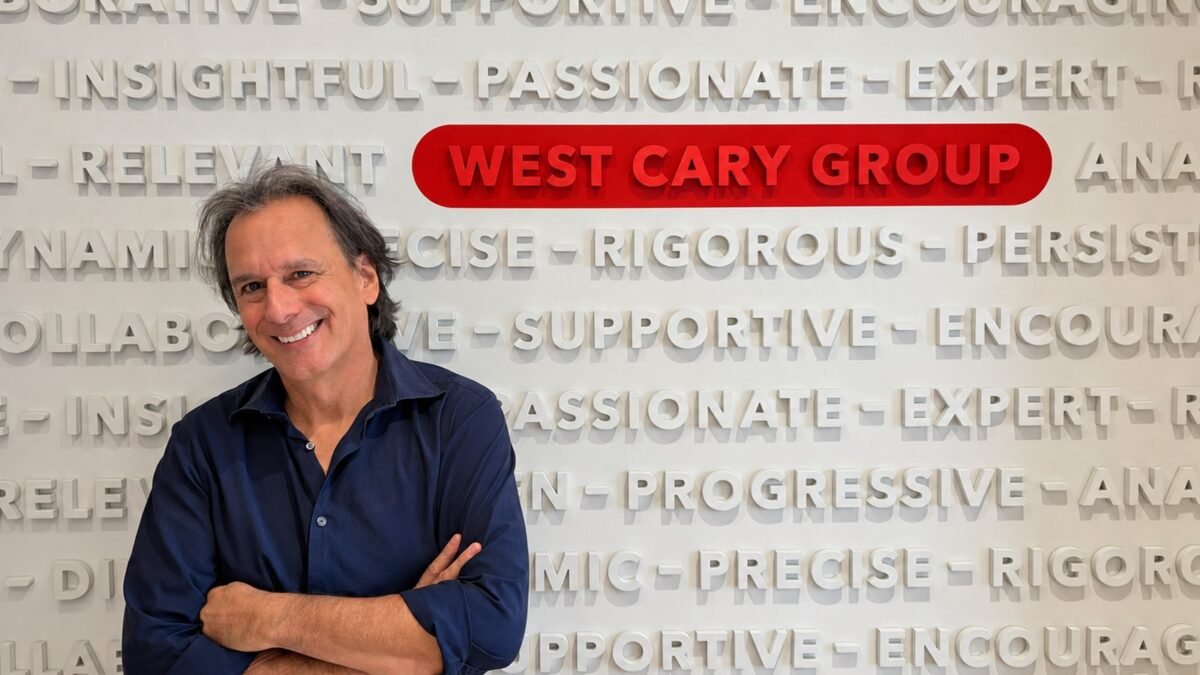
Andy Azula at West Cary Group in Richmond, Virginia. Photo: West Cary Group
Andy Azula is best known as the man with the marker. In UPS’s “Whiteboard” commercials he stood in front of a white board and explained the company’s logistics business by drawing it, one line at a time. He was both the creative director and the face of the campaign, which ran under the “What Can Brown Do For You?” banner and became one of the first ad campaigns to go viral online. This month he returned to agency life as Executive Creative Director of West Cary Group, an independent agency of about 120 people in Richmond, Virginia. Marketing Newsroom asked him what has changed since then and what has not.
Azula’s career runs through The Martin Agency, McCann and Great Minds, with work for Microsoft, Walmart and Pizza Hut. He helped build m:united, the agency McCann set up to serve Microsoft’s global business, and at Fallon he worked on the Buddy Lee campaign for Lee Jeans. At WCG he reports into a creative department led by Chief Creative Officer Debra Fitzgerald. The appointment follows several months in which he worked with the agency as an outside adviser.
“AI can make idea slop, too”
Azula says the question he is joining to answer is how to keep ideas valuable when AI lets anyone make almost anything. His first answer is that the test has not moved. “Does it resonate? Is there some truth in it? Does it respect the audience? Is it a good story well told? And after all the AI tools have touched it, is there still an idea there that’s actually worth putting into the world, spending money on and measuring the results of?”
The risk, as he sees it, is not only bad output. “The danger with AI isn’t just that it makes AI slop. It can make ‘idea slop,’ too. If we let AI do too much of the creative problem-solving, we’re going to get ideas that feel like variations of things that have already worked. That may make them familiar, but not necessarily valuable.”
On how a creative team should work when production is cheap and fast, he starts with what stays the same: the blank page, the brief and the time it takes to understand the problem. AI can speed up research and prototyping, “but that speed should buy us more time to think, push, refine and craft the idea, not just produce a higher volume of work. The danger is confusing output with creativity.”
Would Whiteboard get made today?
Yes, he says, and the case for it may be stronger now. “We’re surrounded by complicated, highly produced, AI-generated imagery. The temptation is to add more simply because we can, or because we feel like we have to keep up with everyone else. But sometimes the thing that stands out is the thing that does less.” Whiteboard worked, in his telling, because the execution matched the problem: UPS had a complicated story, so the agency stripped everything away and let one person explain it with a marker. The media landscape has changed, but the question he would ask is the same. “What is the simplest, most unexpected way to tell this story so somebody actually pays attention?”
On where WCG draws the line with AI, Azula is candid that the agency is still working it out. It uses the tools to research, explore and prototype. “I don’t believe in using AI to speed up the workflow just so we can produce a higher volume of mediocre work. And I definitely don’t want AI becoming the creative director.” A polished comp that helps sell an idea is fine, he says. Showing a client something the agency cannot deliver, or letting the tool make the important design decisions, is not.
“The technology may be global, but the audience never is”
Asked whether the US is ahead of other markets in this, Azula says the challenge is the same everywhere, because the tools are. What differs is culture: humour and visual language travel badly, and what is fresh in one country is a cliché in another. “That’s why I don’t think AI makes local insight less important. It makes it more important. The technology may be global, but the audience never is.”
His advice to young creatives is a list of things the tools cannot do for them. “Learn how to interrogate a brief. Learn how to recognize a real human insight. Learn why an idea works, not just how to make it look finished. Develop taste. Stay curious. And learn how to explain and defend what you believe in.” Newcomers, he adds, have an advantage: no baggage about how things used to be done. They should just not confuse being good at the tools with being good at the job.
Why an agency in Richmond is hiring while others cut
WCG was founded in 2007 by Moses Foster, its President and CEO. Its clients include Capital One, Fannie Mae, Blue Ridge Bank, the City of Philadelphia and the Virginia Department of Health. We asked Foster why the agency says it is growing while much of the industry is cutting back. He gave two reasons. The first is the model: “The combination of world-class data and analytics, powerful strategy and ambitious communications helps us help our clients meet their goals and objectives. We’re not just doing advertising, we’re solving business problems.” The second is focus in new business. “We know where we’re powerful, and we’re powerful in data-driven categories like banking, insurance, energy, and infrastructure, where targeted one-to-one strategies really matter.”
Azula’s job, in Foster’s words, is to add “creative firepower” to an agency built on analytics so it can pitch for larger national campaigns. Azula puts it more simply: WCG has proven it can solve hard problems for big brands, and he wants to put bigger ideas on top of that. “I realized I didn’t just want to advise from the outside. I wanted to help make it happen.”
The hire runs against the grain of a year in which several well-known creatives have left the big networks. In September Rich Silverstein left Goodby Silverstein & Partners, and WPP moved McCann’s Tyler Turnbull to run its new WPP Creative unit.
Sources
- West Cary Group — press release of 20 October 2026 and email interview with Andy Azula and Moses Foster
- PR Newswire — wire version of the announcement